

In recent years, there has been a significant advancement in the field of Artificial Intelligence (AI) and Augmented Reality (AR). These technologies have become increasingly popular and have the potential to enhance virtual experiences in various fields such as gaming, education, healthcare, and...
A Neural Network Predicts Coffee Harvests Based on Soil Temperature
154
01.07.2026
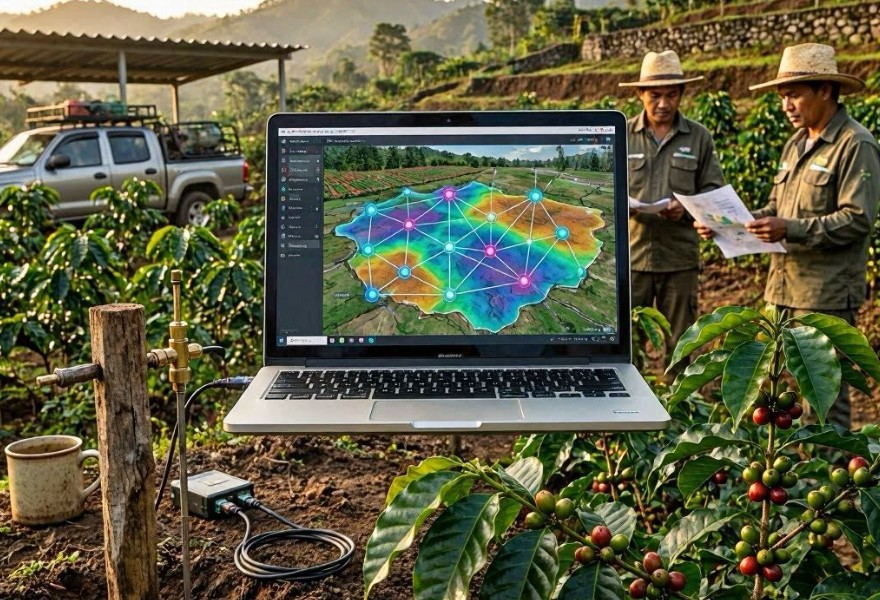
Coffee is perhaps the most sensitive global commodity in the modern world. Grown primarily in the "Bean Belt"—a fragile strip of land between the Tropics of Cancer and Capricorn—coffee plants are notoriously temperamental. They require specific altitudes, precise rainfall, and, most importantly, very particular thermal conditions. For centuries, predicting the size and quality of a coffee harvest has been an exercise in guesswork, relying on the intuition of farmers and historical weather averages. However, climate change is making these traditional methods obsolete. Today, a new technological breakthrough is changing the landscape: the use of neural networks to predict coffee harvests by monitoring the hidden pulse of the farm—the soil temperature.
The relationship between soil temperature and coffee development is profound. It dictates the rate of nutrient uptake, root development, and the plant’s ability to survive stress during the critical flowering stage. By applying deep learning algorithms to this subterranean data, researchers and cooperatives are finally gaining a forward-looking perspective on global supply chains.
The Biological Link Between Soil and Bean
Coffee plants, specifically the *Coffea arabica* species, are highly sensitive to thermal fluctuations in the root zone. If the soil becomes too warm, the plant’s metabolism accelerates, often leading to premature bean maturation and a subsequent loss in flavor complexity and density. Conversely, if soil temperatures remain too low during the flowering phase, the plant may fail to set fruit entirely. The neural network acts as a bridge, translating these subtle thermal variations into accurate yield forecasts.
Data-Driven Predictive Modeling
The prediction system functions through a sophisticated data pipeline that integrates real-time sensors with historic agricultural data. The neural network processes several key inputs:
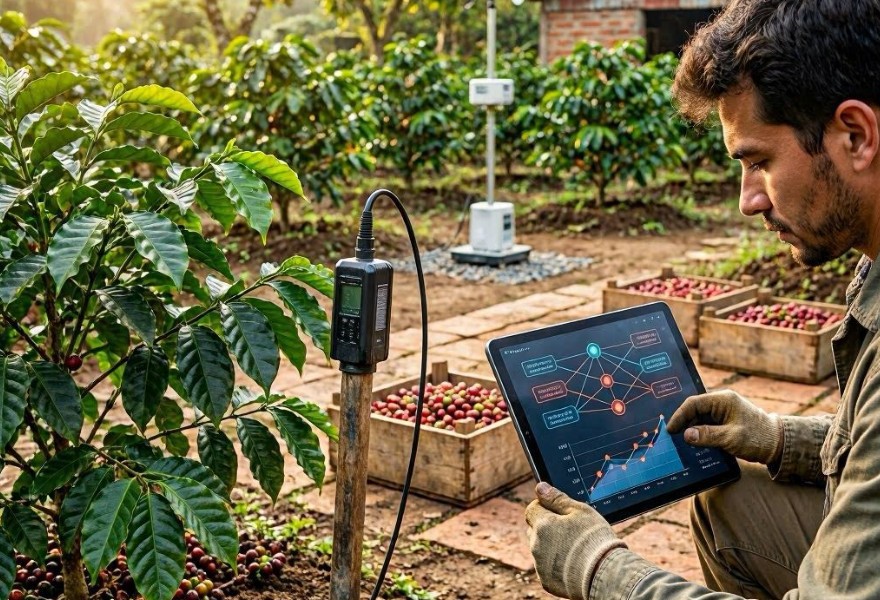
- Subsurface Thermal Sensors: IoT devices buried at the root level provide high-frequency temperature data throughout the day and night.
- Hydraulic Conductivity: The model correlates soil temperature with moisture levels, as heat affects how quickly the soil dries and how effectively the plant absorbs water.
- Phenological Timing: The AI tracks the specific stage of the plant—from dormancy to flowering and cherry development—and weights the temperature data according to the plant's current physiological needs.
Why Neural Networks Outperform Traditional Methods
Traditional agricultural modeling often relies on linear regression, which assumes a fixed relationship between weather and output. However, coffee agriculture is non-linear and incredibly complex. A neural network, specifically one using a Long Short-Term Memory (LSTM) architecture, is uniquely suited for this task.
Capturing Temporal Dependencies
Coffee harvest prediction is a time-series problem. A heatwave that strikes during the flowering phase has a completely different impact on the final yield than one that occurs two months later. The neural network learns these temporal dependencies, "remembering" the stress levels the plant has experienced over the entire growing season. This allows the system to provide a probabilistic yield forecast months before the first cherries are picked.
Transforming the Coffee Supply Chain
The ability to predict harvests with high accuracy—often with a 90% or higher success rate—has massive implications for the global coffee trade. It provides stability to a market that is otherwise prone to extreme volatility.
Stabilizing Prices and Supporting Smallholders
For small-scale farmers, the fear of a failed harvest is a constant threat. With AI-driven predictions, cooperatives can provide farmers with early warnings. If the model predicts a yield shortage due to anomalous soil temperatures, farmers can implement protective strategies—such as mulching or shading adjustments—much earlier. Furthermore, large-scale buyers can use this data to arrange fair-trade financing in advance, protecting farmers from the sudden income shocks that occur during bad harvest years.
Enhancing Sustainability
- Resource Optimization: Farmers can use water and fertilizer more efficiently by knowing exactly how the soil thermal profile is affecting plant uptake.
- Waste Reduction: Logistics and processing centers can plan their staffing and equipment needs based on predicted harvest volume, reducing energy waste and post-harvest spoilage.
The Path Forward
As the neural network continues to ingest more data, its accuracy will inevitably increase. Future versions of these models are expected to integrate satellite-based multi-spectral imaging to complement the subterranean soil data. This holistic view will enable the system to detect plant stress before it even manifests as a change in soil thermal profile.
Conclusion
The integration of neural networks into coffee farming is a masterclass in technological intervention. By listening to the ground—literally—we are ensuring that the world's favorite morning beverage remains a sustainable and reliable part of our future. These predictive models are more than just numbers; they are the tools that will empower coffee farmers to thrive in an increasingly unpredictable climate, ensuring that every bean is nurtured from the soil to the cup.