

In recent years, there has been a significant advancement in the field of Artificial Intelligence (AI) and Augmented Reality (AR). These technologies have become increasingly popular and have the potential to enhance virtual experiences in various fields such as gaming, education, healthcare, and...
A Neural Network Predicts Court Verdicts Based on a Lawyer's Speech
190
24.06.2026
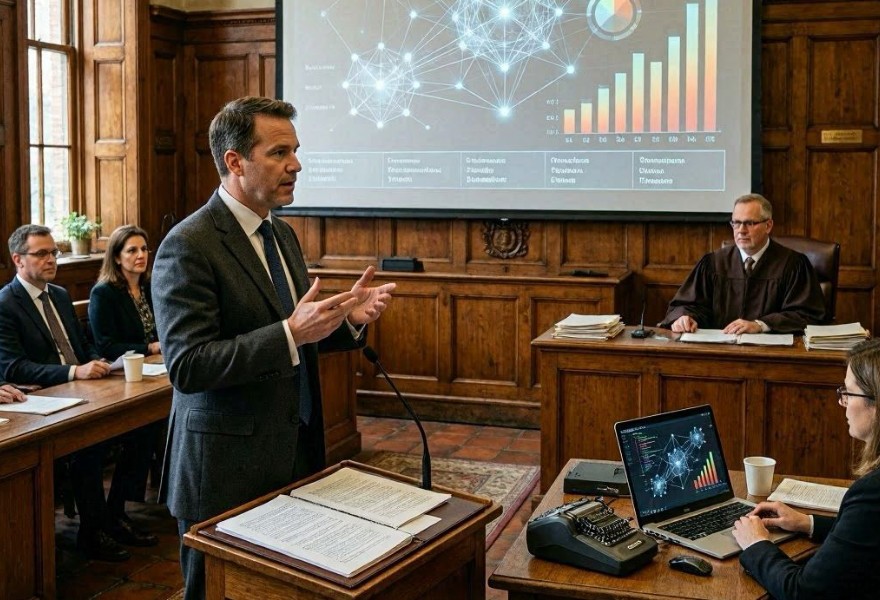
The intersection of law and technology has long been characterized by a cautious, incremental approach. However, recent breakthroughs in artificial intelligence, specifically in natural language processing (NLP), have begun to challenge the traditional opacity of the courtroom. Researchers are now developing sophisticated neural networks capable of analyzing the transcripts of oral arguments made by attorneys to predict final court verdicts with startling accuracy. This development marks a transition from the "black box" of judicial decision-making to a data-driven understanding of how legal persuasion influences the scales of justice.
While the notion of a machine "predicting" a judge's ruling might seem like science fiction, it is grounded in the rigorous analysis of patterns. By treating courtroom oratory as a high-stakes dataset, neural networks can identify subtle linguistic markers and argumentative structures that historically correlate with favorable or unfavorable rulings.
The Anatomy of Legal Persuasion
Legal argumentation is an art form, but it is also a structured exercise in logic and rhetoric. A lawyer’s speech is not just a collection of words; it is a tactical deployment of legal precedents, emotional appeals, and responses to judicial questioning. The neural network dissects this input by examining several layers of communication.
Linguistic and Semantic Analysis
At the core of the algorithm is a transformer-based model—similar to the technology powering advanced AI language processors—that has been fine-tuned on millions of pages of court records. The model analyzes:
- Argumentative Cohesion: How well the lawyer links specific facts to relevant statutes or case law.
- Reaction to Judicial Inquiry: The model maps how the attorney responds to difficult questions from the bench—identifying whether the answers are evasive, assertive, or conciliatory.
- Emotional Tone and Rhetoric: The use of specific phrasing that may trigger psychological biases in judges, which are known to exist despite the formal impartiality of the law.
How the Algorithm Forecasts Outcomes
Predicting a verdict is not a matter of guessing; it is a matter of pattern recognition. The algorithm functions by comparing the current argument against a massive library of past cases where similar attorneys faced similar judges in comparable circumstances.

Training on Judicial History
To be effective, the neural network is trained on the historical records of specific judges. Because every judge has a "judicial footprint"—a unique set of predilections, preferred types of evidence, and sensitivities to certain legal theories—the AI learns to map the lawyer's speech against the idiosyncratic history of the individual on the bench. If a lawyer uses an argumentative style that a particular judge has historically found persuasive, the algorithm assigns a higher probability of a positive verdict.
The Feedback Loop
- Feature Weighting: The AI identifies which parts of the lawyer’s speech—such as the introduction, the rebuttal of a counter-argument, or the closing statement—most influence the court's final opinion.
- Uncertainty Quantification: The model doesn't just provide a binary "guilty" or "not guilty" prediction; it provides a confidence interval, allowing lawyers to understand the risks involved in their current strategy.
Strategic Implications for Legal Practice
The existence of such predictive tools could fundamentally change how law is practiced. Lawyers are increasingly using these AI systems to "stress test" their arguments before ever stepping into the courtroom. By running their planned oral arguments through the algorithm, attorneys can receive a preliminary critique, identifying weaknesses in their logic or areas where their rhetoric may not resonate with the presiding judge.
The Ethical and Legal Frontier
The adoption of AI in the courtroom raises significant ethical questions. If an algorithm suggests that a certain style of speech results in a higher win rate, does this lead to a "homogenization" of legal practice, where lawyers abandon creative, innovative arguments in favor of machine-approved templates? Furthermore, there is the risk of reinforcing existing judicial biases. If the AI learns that a judge historically favors certain types of litigants, it may suggest arguments that exploit those biases rather than challenging them. Transparency in how these models reach their conclusions—"explainable AI"—is therefore essential to ensure that the law remains a tool for justice rather than a system for gaming the outcome.
Conclusion
The ability of a neural network to predict court verdicts based on lawyer speeches represents a profound step toward transparency in the legal system. While no algorithm can replace the wisdom and moral weight of a human judge, these predictive tools serve as invaluable aids for practitioners, offering new insights into the effectiveness of courtroom communication. As AI continues to evolve, the challenge for the legal profession will be to harness these insights to enhance the quality of advocacy without sacrificing the fundamental humanity that the law requires.