

In recent years, there has been a significant advancement in the field of Artificial Intelligence (AI) and Augmented Reality (AR). These technologies have become increasingly popular and have the potential to enhance virtual experiences in various fields such as gaming, education, healthcare, and...
A Program Restores Lost Dialects of Vanished Peoples
204
09.05.2026
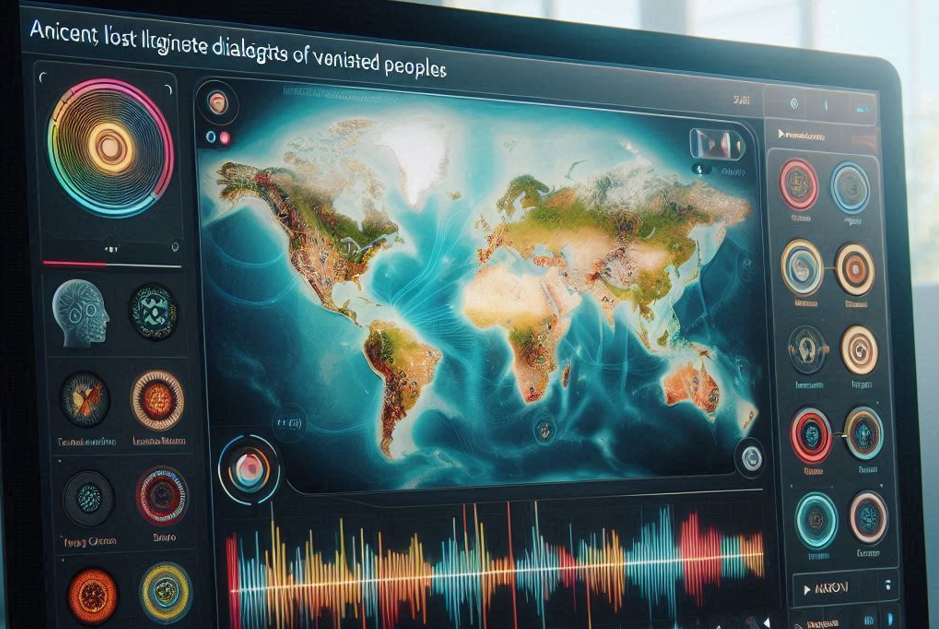
Languages are among the most fragile elements of human culture. While monuments and artifacts may survive for centuries, spoken dialects can disappear within a single generation. When communities vanish or assimilate, their linguistic identity often fades with them. In recent years, researchers have developed a groundbreaking program capable of reconstructing lost dialects of vanished peoples. By combining artificial intelligence, historical linguistics, and cultural analysis, this system offers a new way to recover voices that would otherwise remain silent.
The Disappearance of Dialects
Dialect loss occurs for many reasons, including migration, colonization, globalization, and the dominance of standardized languages. Smaller linguistic communities often abandon their native speech in favor of more widely used languages, leading to gradual erosion.
Unlike fully documented languages, dialects are rarely recorded in detail. They may exist only in fragments—old letters, oral histories, or scattered notes—making reconstruction a complex challenge.
Causes of Dialect Loss
- Urbanization and cultural assimilation
- Educational systems favoring standard languages
- Political and social pressures
- Lack of written records
The Concept of Digital Reconstruction
The program approaches dialect restoration as a puzzle. It gathers all available linguistic fragments and uses them to infer missing elements. Rather than recreating a dialect exactly as it once was, it generates a highly probable reconstruction based on patterns and relationships.
This approach mirrors how historical linguists reconstruct ancient languages, but with significantly greater computational power and data integration.
Key Capabilities
- Analysis of phonetic structures
- Reconstruction of vocabulary and grammar
- Simulation of pronunciation patterns
- Integration of cultural and historical context
Data Sources and Methodology
The system relies on a wide range of data sources. These include written documents, audio recordings (if available), and related languages or dialects. Even indirect evidence, such as place names or borrowed words, can provide valuable clues.
Machine learning models analyze these inputs to identify patterns and generate hypotheses about missing elements.
Types of Data Used
- Historical manuscripts and letters
- Transcriptions of oral traditions
- Comparative linguistic databases
- Ethnographic records

Reconstructing Sound and Structure
One of the most challenging aspects of dialect restoration is reconstructing pronunciation. The program uses phonetic models to estimate how words were likely spoken, based on known sound changes and regional patterns.
Grammar and syntax are also inferred by analyzing related dialects and identifying common structures.
Reconstruction Techniques
- Phonological modeling
- Morphological analysis
- Statistical language modeling
Cultural Context and Meaning
Language is deeply tied to culture, and the program incorporates cultural data to ensure that reconstructed dialects are meaningful. Words related to local traditions, environment, and social structures are given special attention.
This contextual approach helps avoid purely mechanical reconstructions that lack cultural authenticity.
Applications and Impact
The restoration of lost dialects has significant implications for both academic research and cultural preservation. Linguists gain new insights into language evolution, while communities can reconnect with their heritage.
Key Applications
- Revitalization of endangered languages
- Educational programs and cultural initiatives
- Historical research and documentation
Ethical Considerations
Reconstructing a dialect raises questions about authenticity and representation. Since the results are probabilistic, it is important to present them as reconstructions rather than definitive versions.
Collaboration with descendant communities is essential to ensure respectful and accurate use.
The Future of Linguistic Restoration
As technology advances, the accuracy and scope of such programs will continue to improve. Integration with speech synthesis may allow reconstructed dialects to be spoken and heard, bringing them closer to life.
Ultimately, this innovation demonstrates how technology can preserve and revive cultural heritage, ensuring that even lost voices can be heard once again.