
In recent years, there has been a significant advancement in the field of Artificial Intelligence (AI) and Augmented Reality (AR). These technologies have become increasingly popular and have the potential to enhance virtual experiences in various fields such as gaming, education, healthcare, and...
AI Helps Archaeologists Locate Burials Beneath Layers of Soil
81
06.08.2026
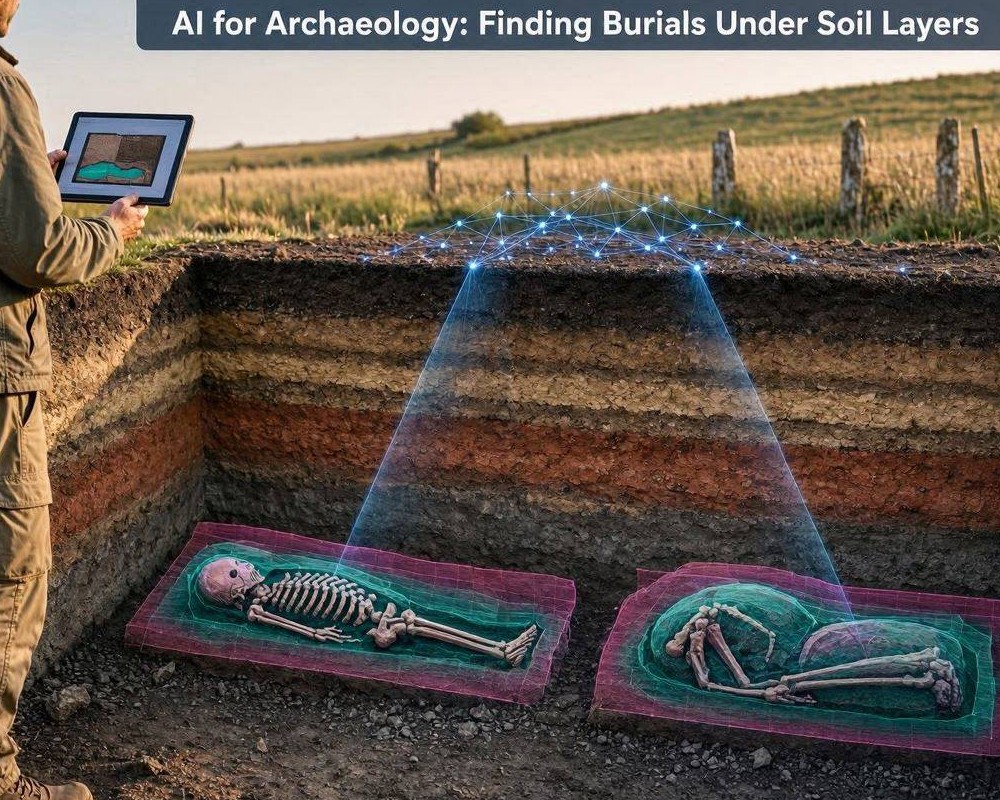
Hidden beneath fields, dunes, and collapsed structures, burials are often protected by layers of soil that blur the evidence of what lies below. Traditional excavation can confirm discoveries, but it is costly, slow, and sometimes destructive. In recent years, artificial intelligence (AI) has emerged as a practical partner for archaeologists—helping them detect burial-related features earlier, prioritize survey areas, and make fieldwork more targeted.
Why burials are hard to locate
Burials rarely present as obvious landmarks on the surface. Over time, natural processes such as erosion, sedimentation, and root growth can bury human remains under thick deposits. Even when ground-penetrating radar (GPR), magnetometry, or LiDAR are used, the resulting signals can be noisy or ambiguous. A shallow pit may look similar to a refuse trench; a void can resemble a geological cavity; and disturbed soil can mimic later disturbances from farming or construction.
AI is particularly useful here because it can learn patterns from many datasets, including those from past excavations where ground truth is known. Instead of relying solely on manual interpretation, researchers can convert complex measurements into probabilistic maps of likely burial locations.
How AI works in archaeological detection
AI applications in burial discovery typically follow a workflow: collect subsurface or surface-related data, preprocess it, train or apply models, and validate results through targeted digging or non-invasive confirmation.
1) Data collection from multiple sensing methods
Archaeologists often combine complementary tools to compensate for the weaknesses of any single method. Common inputs include:
- Ground-penetrating radar profiles that reveal subsurface reflections and discontinuities.
- Magnetometry readings that can detect magnetic variations caused by burned features or disturbed sediments.
- Electrical resistivity surveys that highlight contrasts in moisture and soil composition.
- Photogrammetry and LiDAR that map microtopography and subtle surface anomalies.
2) Pattern recognition in complex signals
Machine learning models—such as convolutional neural networks and other pattern-recognition systems—can be trained to identify features consistent with burial structures. These may include rectilinear cuts, consistent depth ranges, burial fill differences, or repeated signatures across survey grids. In practice, AI often outputs a “likelihood” score rather than a definitive answer, which helps teams focus resources where evidence is strongest.
3) Data fusion for more reliable predictions
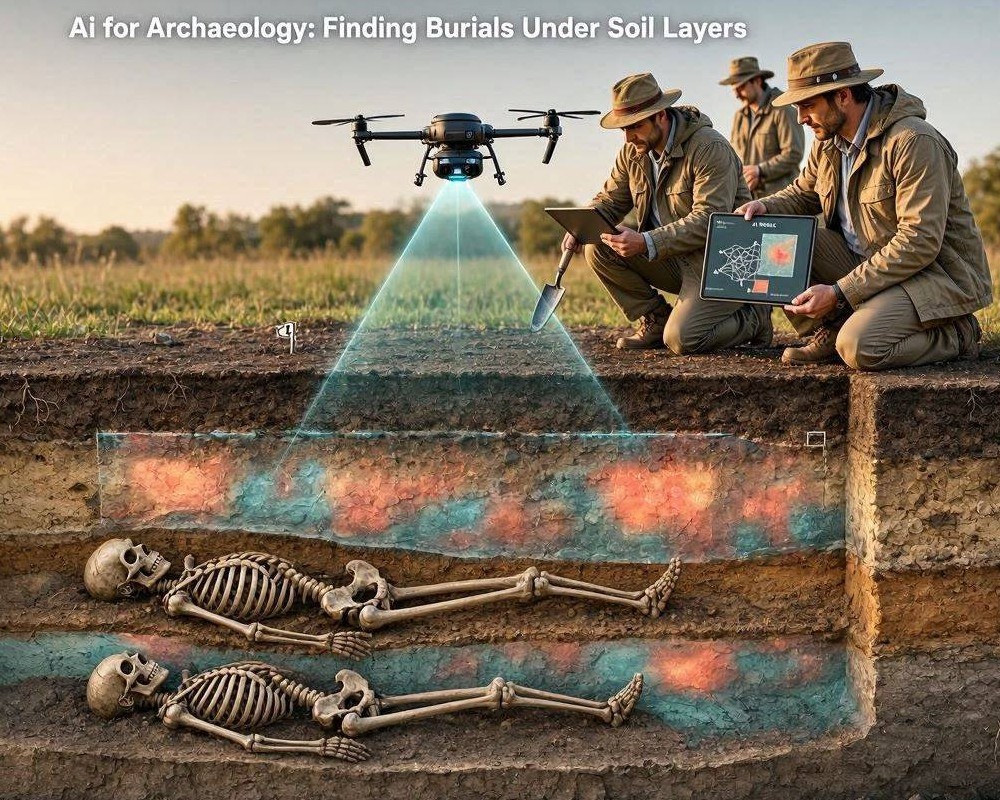
One of AI’s biggest advantages is its ability to fuse data layers. A single sensor may produce misleading results due to moisture, metal debris, or varying soil stratigraphy. When AI integrates radar reflections with magnetometry anomalies and topographic signals, the combined evidence becomes more robust. Researchers can then generate interpretable heatmaps or ranked lists of target zones.
From probability maps to field decisions
AI does not replace archaeological expertise; it streamlines decision-making. After a model highlights potential burial-related anomalies, archaeologists still assess context: stratigraphy, site history, spatial relationships to known features, and cultural landscape considerations.
Teams commonly use AI outputs to:
- Prioritize survey lines and adjust survey density where uncertainty is highest.
- Plan minimal-impact sampling strategies, such as narrow test pits or targeted coring.
- Improve interpretation by comparing model-ranked anomalies with on-the-ground observations.
- Document decisions transparently so that future research can review the reasoning and methods.
Benefits and limitations of AI-assisted burial discovery
Key benefits
- Non-invasive prioritization: Models help reduce unnecessary excavation by guiding fieldwork to the most promising areas.
- Faster interpretation: Large survey grids can be assessed more quickly than manual review alone.
- Better detection under soil layers: AI can identify subtle, repeatable patterns that are difficult for the human eye to isolate.
Limitations to address
AI systems depend on data quality and representativeness. If training data comes from different soil types, burial styles, or survey settings, performance may drop. Models can also produce false positives—flagging disturbances from later activities or natural voids as burial candidates. For these reasons, validation remains essential: results must be checked against stratigraphy, excavation findings, and, where possible, independent survey methods.
What the future looks like
As more archaeological projects share datasets and best practices, AI models will become more transferable across regions and time periods. Researchers are also exploring explainable AI techniques that highlight which parts of a radar profile or sensor reading drove a prediction. That transparency can help archaeologists understand model behavior, build trust, and refine workflows.
Ultimately, AI is reshaping archaeology from a largely reactive discipline into a more anticipatory one—helping researchers locate burials beneath layers of soil with greater precision, less disturbance, and stronger evidence before excavation even begins.