

In recent years, there has been a significant advancement in the field of Artificial Intelligence (AI) and Augmented Reality (AR). These technologies have become increasingly popular and have the potential to enhance virtual experiences in various fields such as gaming, education, healthcare, and...
AI Learned to Predict Shark Migration by Ocean Temperature
73
07.08.2026

Shark migrations have long been difficult to forecast. These journeys span vast distances, shift with currents, and respond to seasonal changes in water conditions. Now, a new wave of research shows that artificial intelligence can learn migration patterns using one of the most accessible environmental signals: ocean temperature. By connecting thermal conditions to movement behavior, AI models can help scientists anticipate where sharks may travel next—supporting safer fisheries management, more efficient tagging, and better conservation planning.
Why ocean temperature matters for shark movement
Ocean temperature influences more than comfort for marine animals. For sharks, it affects metabolic rate, prey distribution, and habitat suitability. Many shark species follow thermal “bands” that align with feeding grounds or breeding areas. When temperatures warm or cool across a region, prey species often shift accordingly, indirectly steering predators.
Temperature also interacts with oceanographic features such as upwelling zones, thermoclines, and current systems. Even if a shark’s destination is driven by food availability, temperature can serve as a reliable proxy for the broader ecosystem state. That makes it an excellent input variable for predictive learning.
How the AI model learns migration patterns
To build a temperature-based migration predictor, researchers combine animal movement data with environmental observations. Typically, satellite tags or tracking programs provide time-stamped location data for individual sharks. In parallel, ocean temperature data come from satellite-derived products, buoy measurements, or reanalysis datasets.
The core idea is to train the AI system to map temperature conditions over time to likely next locations or routes. Instead of relying on a single “preferred temperature,” the model learns how sharks respond to spatial gradients and seasonal trajectories.
Key steps in the workflow
- Data alignment: matching shark locations and timestamps to temperature measurements at corresponding times and coordinates.
- Feature engineering: creating variables such as temperature anomalies, local averages, and vertical or horizontal temperature gradients.
- Model training: using machine learning methods that can capture nonlinear relationships and temporal dependencies.
- Validation: testing forecasts on held-out tracking periods to confirm predictive performance.
What the model actually predicts
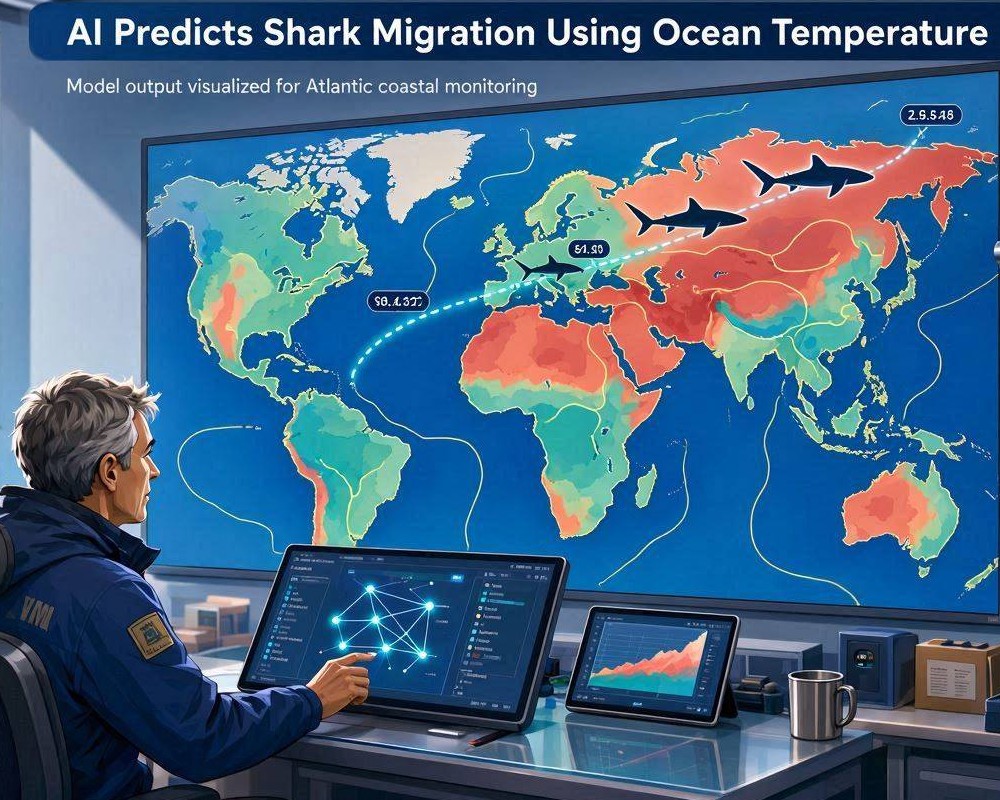
Depending on the study design, AI outputs can include probability maps for presence, estimated routes between regions, or time windows when sharks are most likely to arrive. This probabilistic framing is crucial: migration is not a fixed timetable, and ocean conditions change continuously.
Measuring success: more than accuracy scores
Predicting migration isn’t simply about minimizing error distances. Researchers evaluate whether forecasts meaningfully improve decision-making. For example, better predictions can reduce uncertainty for researchers planning fieldwork and can help fisheries adjust operations to reduce bycatch.
Common evaluation approaches include:
- Temporal robustness: performance across multiple seasons and years.
- Spatial generalization: ability to predict in new regions beyond the training area.
- Scenario testing: checking outputs under different temperature regimes, such as marine heatwaves.
Benefits for conservation and ocean management
Reliable temperature-driven forecasts can strengthen marine stewardship in several ways. First, they make it easier to anticipate where sharks will concentrate, enabling targeted monitoring with fewer resources. Second, managers can incorporate migration likelihood into dynamic ocean zoning, potentially reducing unwanted interactions in high-risk areas. Third, AI-driven insights can guide tagging strategies—choosing tag deployment locations and timing to maximize the chance of capturing informative movement segments.
In addition, these models can become early warning systems. When forecasts indicate a shift toward atypical thermal habitats, scientists may investigate whether prey changes, climate anomalies, or habitat disruptions are influencing migration.
Limitations and what comes next
Temperature alone will not explain every movement decision. Sharks may respond to salinity, oxygen levels, currents, moonlight, or prey behavior—factors that can vary independently from temperature. There are also biases in tracking data: tag placement, sampling frequency, and coverage gaps can shape what the AI learns.
Future work increasingly aims to integrate temperature with complementary signals. For example, combining temperature with chlorophyll concentration (a proxy for productivity), current velocity, or bathymetry may yield more complete habitat models. Researchers may also explore transfer learning across species, so one model’s lessons can inform predictions for related sharks with fewer tracking records.
Even with these challenges, the central breakthrough remains significant: AI can uncover strong, learnable links between thermal conditions and migration behavior. As ocean datasets improve and tracking expands, temperature-informed predictions may become a practical tool for protecting sharks in a changing climate.