

In recent years, there has been a significant advancement in the field of Artificial Intelligence (AI) and Augmented Reality (AR). These technologies have become increasingly popular and have the potential to enhance virtual experiences in various fields such as gaming, education, healthcare, and...
An algorithm builds ambulance routes in real time
43
09.08.2026
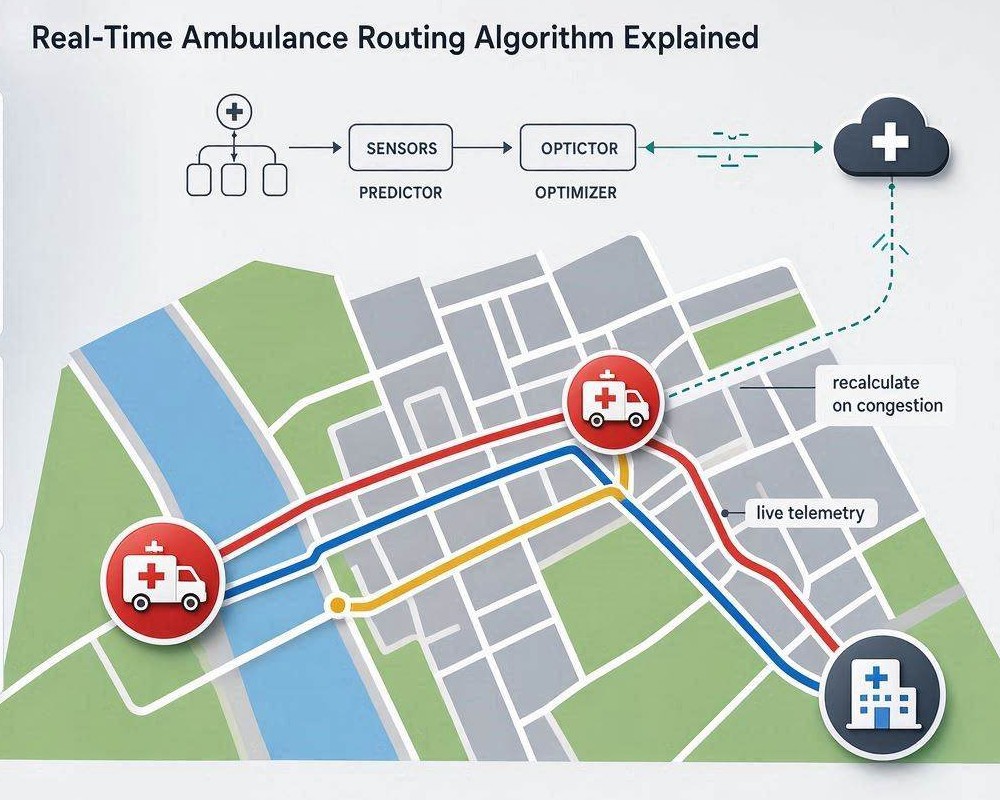
Every second matters in emergency response. A modern routing algorithm for ambulances is designed to produce the best possible path at the moment it’s needed—while continuously adapting to new information such as traffic changes, incident updates, and hospital availability. Unlike static route planners, the real-time approach treats routing as a living decision process that updates as the world changes.
Why real-time routing is different from classic navigation
Traditional navigation computes a route once and assumes conditions remain stable. Emergency logistics cannot afford that assumption. Response times depend on factors that shift minute by minute: congestion patterns, road closures, weather, and even the moment-by-moment load at receiving facilities. A real-time algorithm therefore focuses on decision under uncertainty, updating routes as fresh data arrives.
Core objectives the algorithm optimizes
Most systems aim to balance multiple objectives rather than minimizing distance alone. Typical goals include:
- Minimizing estimated time of arrival (ETA) for the patient.
- Reducing expected delay to definitive care by matching incidents to appropriate hospitals.
- Considering ambulance availability, crew constraints, and dispatch rules.
- Ensuring route feasibility with live map data and operational policies.
Inputs the algorithm uses in real time
The quality of routing depends on the accuracy and freshness of input data. A real-time system usually combines structured operational data with live mobility signals.
Operational and clinical constraints
Ambulance routing cannot ignore constraints that affect patient outcomes:
- Hospital capacity: emergency department load, current triage status, and divert policies.
- Service compatibility: whether a hospital can provide the required level of care.
- Ambulance status: whether units are on scene, transporting, or available for dispatch.
Mobility and environment data
To predict travel time reliably, the algorithm ingests mobility signals such as:
- Traffic speed estimates by road segment.
- Incident or construction closures affecting travel time.
- Weather conditions that change road speed profiles.
- Historical reliability of travel-time predictions on similar routes.
The real-time routing workflow
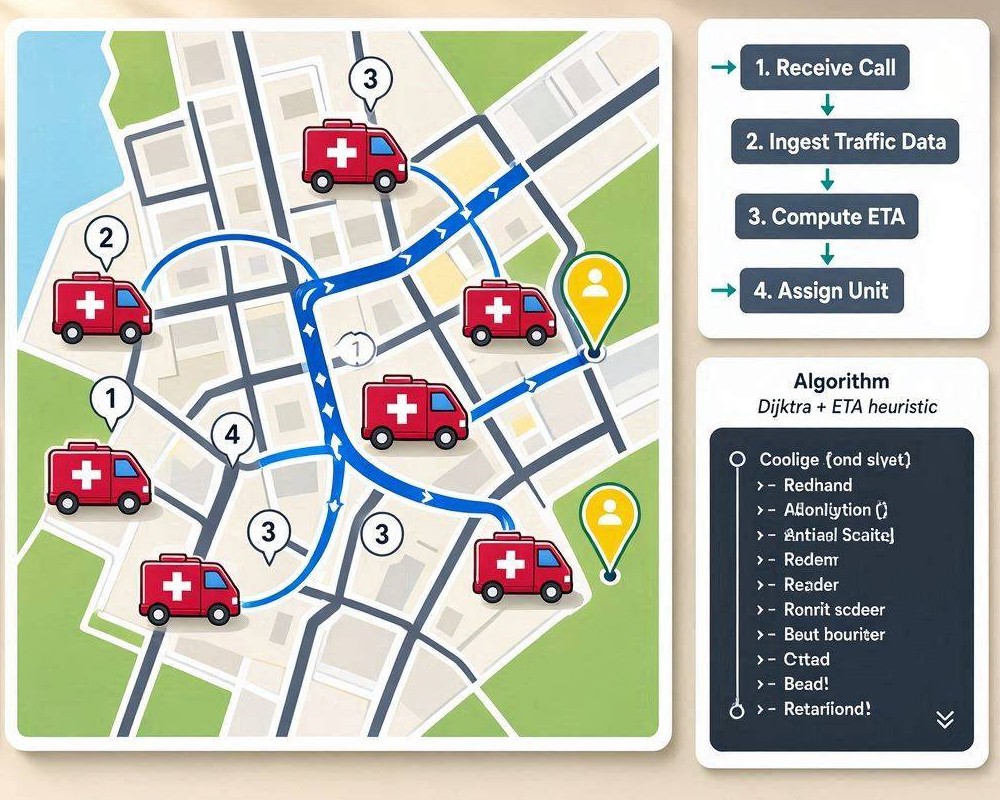
In practice, the algorithm follows a cycle: observe new events, update models, compute candidate routes, and finalize dispatch decisions. Because emergency requests arrive unpredictably, the system must respond quickly while maintaining stable operations.
Step 1: Build a candidate set of routes
When an incident occurs, the system identifies feasible destinations (e.g., hospitals that can accept the case). Instead of searching every possible path, it generates a candidate set using fast graph-based methods. Roads are modeled as a network, and each segment has dynamic travel-time estimates.
Step 2: Estimate travel time with live conditions
Travel time is modeled as a function of segment-level speeds and their uncertainty. Good implementations incorporate probabilistic estimates so that the route with the best average ETA also accounts for variability—important when traffic spikes or a closure suddenly appears.
Step 3: Evaluate ambulance and hospital matching
Candidate routes alone are not enough. The algorithm scores each option by considering which ambulance can execute it and whether the hospital will likely be able to receive the patient at arrival time. This is where capacity prediction and dispatch policy rules come into play.
Step 4: Select the dispatch plan and set monitoring triggers
The algorithm chooses the best route-plan for the next action (often “dispatch this unit now”), then sets triggers for recalculation. Recomputing continuously is costly; instead, the system updates when the expected benefit is high—such as when ETA worsens beyond a threshold or hospital capacity changes.
How the algorithm stays accurate at scale
Real-time ambulance routing must handle many concurrent incidents and frequent data updates. Several strategies help maintain performance and reliability.
Incremental updates instead of full re-planning
Rather than recompute everything from scratch, systems reuse earlier computations and update only affected parts of the route graph. This reduces latency and keeps dispatch decisions responsive.
Fallback behavior when data is incomplete
In real deployments, signals can be delayed or missing. A robust algorithm uses fallback rules: default travel-time profiles, conservative hospital assumptions, and conservative routing when uncertainty is high. The goal is not perfect accuracy at every moment, but safe and effective decisions.
Auditability and safety checks
Because errors carry serious consequences, many systems produce explainable outputs: why a destination was selected, how ETA was computed, and what constraints were enforced. This supports clinical governance and operational review.
What “best route” means in real operations
The most important insight is that “best” is not a single metric. A real-time ambulance routing algorithm continuously reconciles competing requirements—speed, clinical appropriateness, and system-wide constraints. By updating decisions with live data, it shortens the gap between incident detection and effective transport.
When implemented well, the result is a dispatch engine that behaves like a real-time navigator for emergencies: fast enough to act immediately, intelligent enough to adapt, and reliable enough to support high-stakes decisions.