
In recent years, there has been a significant advancement in the field of Artificial Intelligence (AI) and Augmented Reality (AR). These technologies have become increasingly popular and have the potential to enhance virtual experiences in various fields such as gaming, education, healthcare, and...
An Algorithm Reconstructs Lost Symphony Notes from Composers' Diaries
21
12.08.2026
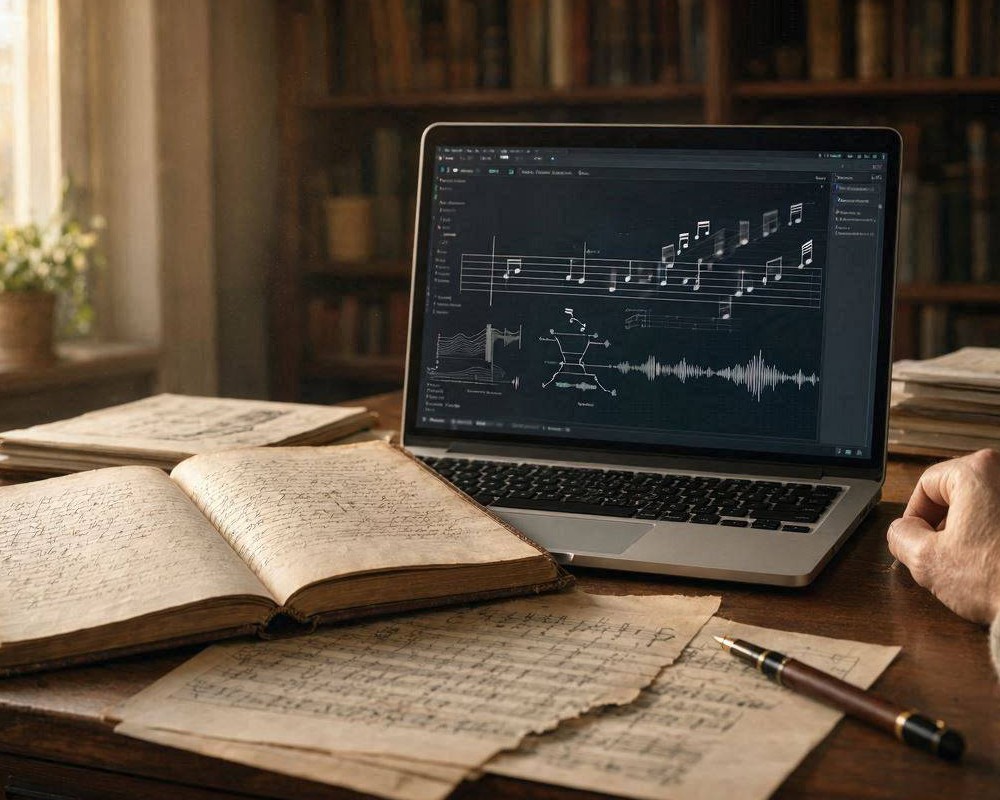
In music history, the worst kind of loss is not silence but absence of detail: missing pages, crossed-out measures, and diaries that mention ideas without recording them fully. A recent wave of research shows how an algorithm can bridge that gap by reconstructing lost symphony notes from composers’ personal writings. The result is not a perfect replica of the original score, but a disciplined, evidence-based reconstruction that helps scholars test musical hypotheses and audiences hear “lost” fragments with new clarity.
Why diaries matter when scores are incomplete
Composers’ diaries, letters, and sketchbooks often capture the thinking behind the music—motifs, emotional goals, orchestration choices, and even timing references. Unlike a finished score, diaries may be fragmentary: a line about “the violins entering after the first theme dissolves” or a reminder to “repeat the cadence but change the harmony.” These notes become crucial when the manuscript is missing measures or when performance parts never survived.
Still, turning diary text into actual musical notes is hard. The same phrase can refer to different passages, and dates do not always align with composition stages. The algorithm’s advantage lies in treating diaries as structured evidence rather than as inspiration alone.
How the reconstruction algorithm works
At a high level, the system transforms diary content into probabilistic musical constraints, then searches for a set of notes that satisfies them while staying consistent with known style and harmonic behavior.
1) Extracting musical constraints from text
The first step converts natural-language diary entries into usable signals. The algorithm identifies entities such as instruments (“bassoons”), musical functions (“cadence,” “modulation”), and temporal cues (“after the development,” “during the coda”). It also detects patterns that imply pitch or rhythm indirectly, including references to intervals (“a third higher”) or to recurring motifs (“same as the opening, but darker”).
2) Mapping language to musical features
Next, extracted cues are mapped to features that a music model can evaluate: scale degrees, probable harmonic targets, voice-leading tendencies, and rhythmic densities. For example, “a more urgent rhythm” might shift the probability toward shorter note values or higher rhythmic activity in that passage. When diaries mention specific chords or keys, the constraints tighten; when they only describe character, the algorithm uses broader priors.
3) Generating candidate measures under stylistic priors
The algorithm then generates candidate musical continuations for the missing segment. It uses learned stylistic priors derived from the composer’s surviving works—or from a corpus of similar compositions—so the reconstructed passage sounds plausible rather than generic. Crucially, it scores each candidate against both diary-derived constraints and formal music logic (for instance, whether cadence endings “fit” the surrounding harmonic progression).
4) Ranking and uncertainty estimates
Because diary information can be ambiguous, the system outputs rankings rather than single answers. A reconstruction might include a primary version plus alternatives for contested measures. Scholars benefit from this transparency: they can compare which diary phrases support which musical choices and where the evidence is weak.
What counts as “reconstructed” vs. “invented”
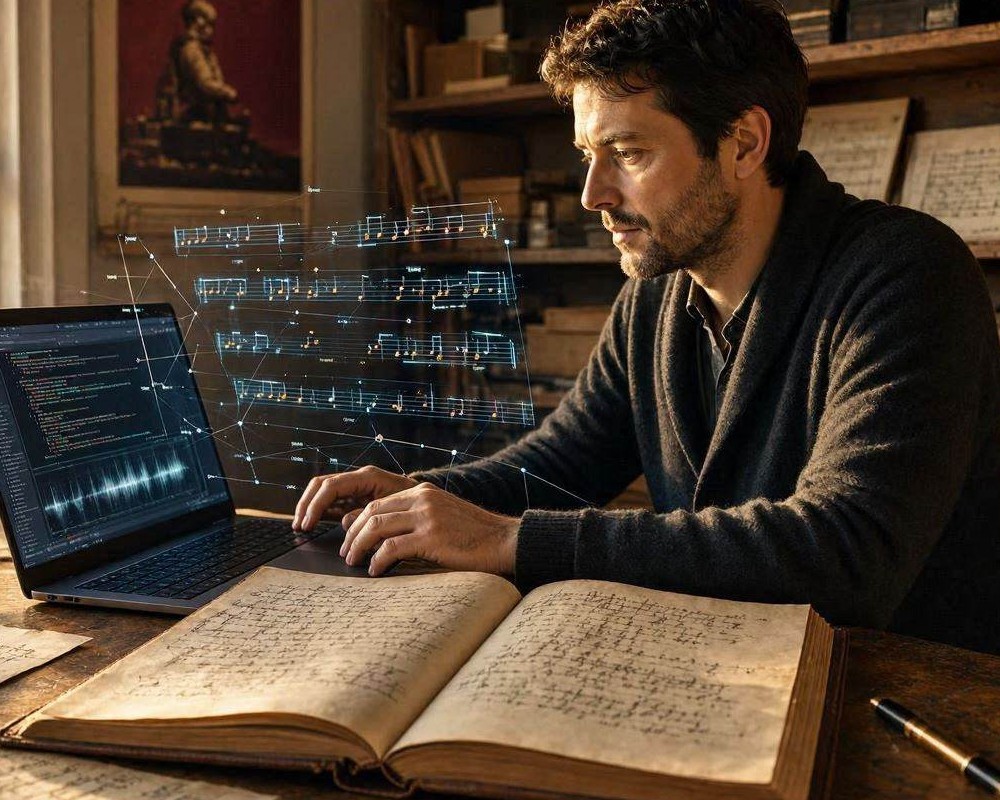
A well-designed tool must separate evidence-based completion from creative extrapolation. In this approach, “reconstructed” means the notes are selected because they satisfy specific diary constraints and match statistically learned patterns. “Invented” elements are those that remain unconstrained—filled in by stylistic priors where diaries provide no guidance.
To prevent overconfidence, the algorithm highlights:
- Measures with strong textual anchors (e.g., explicit references to cadence type or orchestration).
- Measures with medium anchors (e.g., mood descriptions that imply multiple rhythmic possibilities).
- Measures with low anchors (where style priors drive most of the content).
Applications for scholars, performers, and listeners
Reconstruction tools can transform how music is researched and practiced. For scholars, they offer testable restorations: historians can ask whether a diary’s “repeated cadence” aligns with harmonic plans in the surrounding surviving sections. For performers, the output provides an actionable draft for rehearsals, especially when only partial orchestrations remain. For listeners, it reframes “lost” music as a subject of ongoing study rather than a sealed archive.
However, ethical use matters. Reconstructions should be labeled clearly and compared against manuscript evidence. When multiple candidates exist, presenting alternatives respects uncertainty and avoids presenting probability as certainty.
The next frontier: from notes to intentions
The most exciting direction is not only rebuilding pitch and rhythm, but recovering compositional intention: how themes evolve, why an orchestration changes, and how tension resolves. As algorithms improve at linking linguistic nuance to musical structure, diary-based reconstructions may become richer—capturing not just what might have been written, but how the composer thought.
Lost symphony notes may never fully return, yet these systems demonstrate a powerful truth: even fragmented human records can guide precise musical reconstruction when computation is paired with rigorous interpretation.