

In recent years, there has been a significant advancement in the field of Artificial Intelligence (AI) and Augmented Reality (AR). These technologies have become increasingly popular and have the potential to enhance virtual experiences in various fields such as gaming, education, healthcare, and...
An Algorithm Restores Washed-Out Inscriptions on Ancient Stones
68
11.09.2026
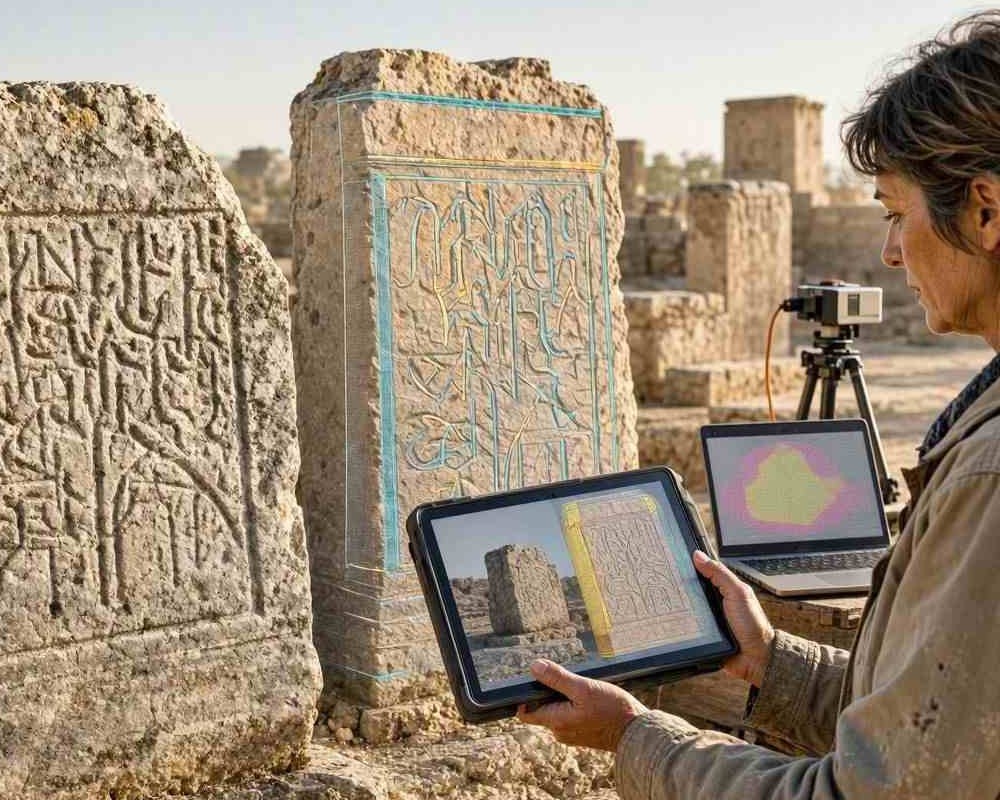
Centuries of rain, wind, salt, pollution, and human contact can reduce a carved inscription to a surface that appears almost blank. Archaeologists have traditionally relied on angled lighting, tracings, photography, and physical casts to identify surviving marks. A new generation of computational imaging algorithms offers a safer and more precise alternative: digitally recovering faint letters without touching or altering the stone.
How Digital Inscription Restoration Works
The algorithm does not rebuild the monument or invent missing text. Instead, it processes detailed images of the surface and emphasizes subtle differences associated with carving. These clues may include shallow depressions, changes in texture, microscopic shadows, and variations in reflected light. By combining evidence from multiple photographs, the system can generate an enhanced representation in which eroded strokes become easier to distinguish.
Capturing the Stone Surface
Reliable restoration begins with controlled image acquisition. Researchers photograph the inscription from a fixed position while changing the direction of illumination. A groove that disappears under frontal light may cast a detectable shadow when illuminated from the side. Photogrammetry or structured-light scanning can also produce a three-dimensional model containing depth information that ordinary photographs cannot record accurately.
Separating Carving from Natural Damage
Ancient stones contain cracks, mineral veins, lichen, tool marks, and irregular grains. These features can resemble letters, making simple contrast enhancement unreliable. A trained recognition model examines geometric patterns across the surface and estimates which lines are likely to be intentional. Repeated stroke widths, aligned baselines, familiar character shapes, and consistent cutting angles help separate writing from random erosion.
Key Stages of the Algorithm
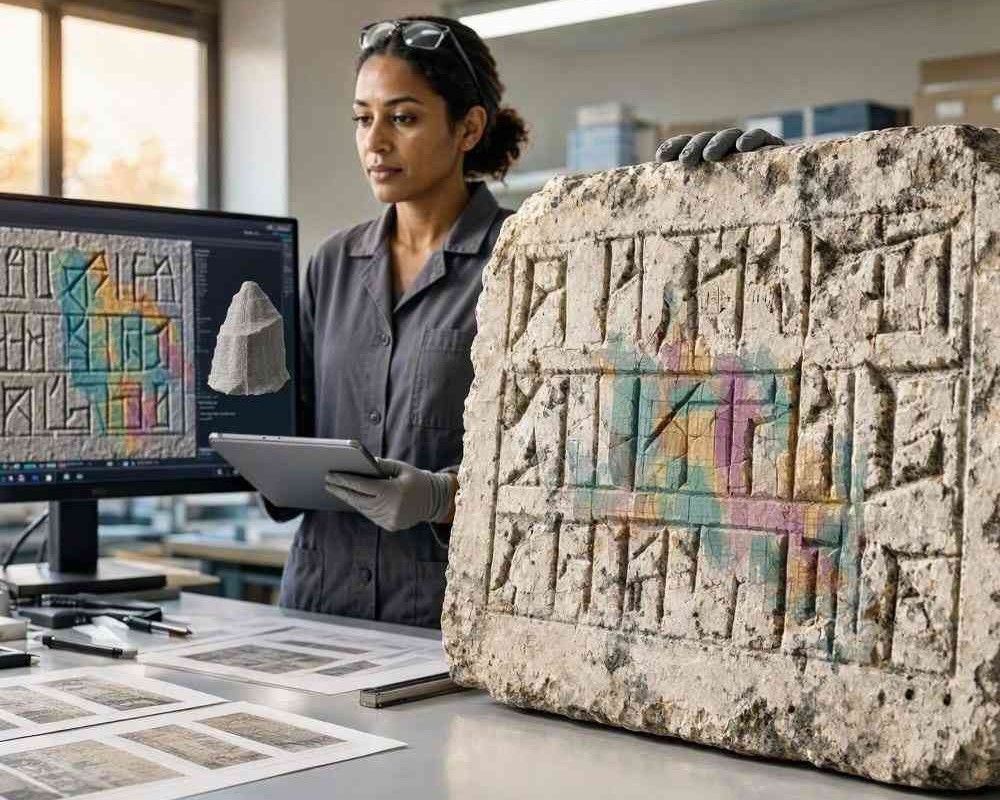
Although implementations vary, most computational restoration systems follow a transparent workflow. Each stage should preserve the original data so that specialists can compare the enhanced result with unprocessed scans.
- Image alignment: Photographs taken under different lighting conditions are matched at pixel level.
- Surface reconstruction: Depth, reflectance, and texture maps describe the stone’s physical features.
- Noise reduction: Filters suppress stains, grain, and imaging artifacts without erasing shallow cuts.
- Stroke detection: The algorithm identifies connected grooves that may belong to characters.
- Confidence mapping: Every proposed letter receives a probability score for expert review.
Benefits for Archaeology and Conservation
Non-Contact Analysis
Fragile monuments can be studied without chalk, rubbing paper, silicone molds, or repeated handling. This is especially important for sandstone, limestone, and painted surfaces that may lose material under pressure. Digital records also let researchers revisit an inscription after excavation, compare readings remotely, and test alternative interpretations without returning to the site.
Faster Comparison and Documentation
Once characters become visible, software can compare them with known alphabets, regional scripts, and dated inscriptions. This does not replace epigraphers, but it narrows the search and highlights unusual forms. Enhanced models can support translations, museum displays, accessibility projects, and online archives. They also create a measurable baseline for monitoring future erosion or vandalism.
Why Human Verification Remains Essential
Computational enhancement can produce convincing lines where no deliberate carving exists. A responsible workflow therefore displays uncertainty and avoids presenting reconstructed words as established fact. Epigraphers must evaluate linguistic context, carving technique, letter order, and archaeological provenance. Ideally, publications should provide original photographs, processed images, three-dimensional data, and confidence maps together. Used with this level of transparency, the algorithm becomes a powerful reading aid rather than an automated author of the past.