

In recent years, there has been a significant advancement in the field of Artificial Intelligence (AI) and Augmented Reality (AR). These technologies have become increasingly popular and have the potential to enhance virtual experiences in various fields such as gaming, education, healthcare, and...
An algorithm selects the optimal daily routine based on a person's biorhythms
17
13.08.2026
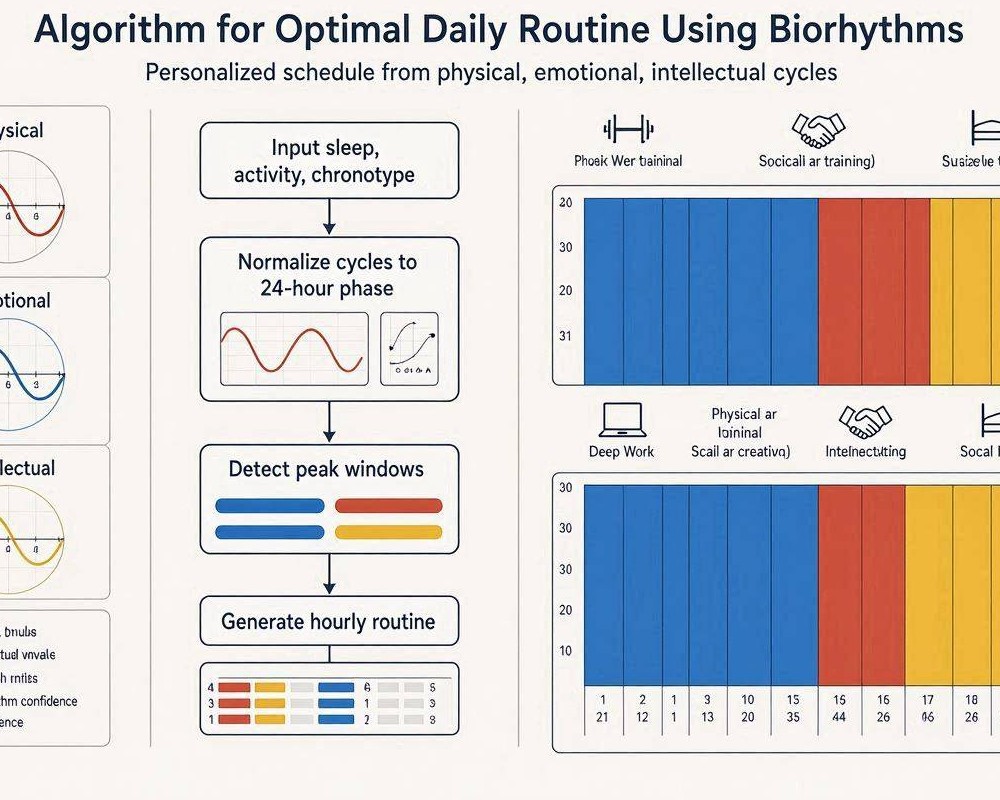
Imagine a system that doesn’t just track your day, but actually shapes it. An algorithm can select an optimal daily routine by combining biorhythm concepts with real behavioral signals—sleep timing, activity levels, and subjective energy. The goal is simple: schedule work, training, meals, and recovery during the windows when you’re most likely to perform well and feel stable.
What “biorhythms” means in a practical algorithm
Traditional biorhythm theories describe periodic cycles that influence mood, energy, and physical capability. In modern routine-building systems, these ideas are translated into measurable rhythms and then adjusted using personal data.
An effective algorithm typically treats “biorhythms” as a layered model:
- Sleep-wake rhythm: Your circadian alignment, often strongest and most reliable.
- Energy fluctuations: Daily peaks and troughs inferred from wearables or logs.
- Performance sensitivity: How your focus and decision quality change across the day.
- Recovery needs: Recovery capacity that affects how quickly you bounce back.
Instead of assuming one universal cycle, the algorithm learns your personal pattern and then maps it to real tasks.
How the algorithm builds an optimal routine
At the core, the algorithm is a scheduler. It searches for a daily plan that balances productivity with sustainability. The challenge is that human performance is not constant—so the system must predict when you’re most likely to do certain types of work well.
1) Data collection and signal smoothing
The algorithm starts with inputs such as:
- Sleep onset and wake times (manual or device-based)
- Heart-rate variability or movement trends (where available)
- Self-ratings of energy, stress, and focus
- Task outcomes (completion quality, speed, or error rates)
Because real life is noisy, it smooths signals to avoid overreacting to an unusually bad morning or a one-off late night.
2) Cycle estimation and personal calibration
Next, the algorithm estimates your rhythm parameters and updates them over time. For example, it may determine that your peak concentration occurs earlier on weekdays than on weekends due to consistent wake times—or that late caffeine shifts your afternoon dip.
This calibration step is crucial. A routine built from generic cycles often feels wrong because it ignores your lived pattern.
3) Task-to-energy mapping
Then the algorithm assigns “types of tasks” to “types of energy states.” Typically:
- High-cognitive tasks (deep work, planning, coding, writing) are scheduled near predicted focus peaks.
- Creative or exploratory tasks land in times of moderate energy with lower stress pressure.
- Routine admin (email, scheduling, bookkeeping) is placed into predictable low-energy windows.
- Physical training is matched to your recovery capacity and temperature/mobility rhythms where possible.
4) Constraints and “reality checks”
An optimal routine is not only about peak performance—it must respect constraints. The system accounts for meetings, commute times, meal windows, medication schedules, and your historical ability to stick to plans. It also includes buffers to prevent burnout cascades after a late evening.
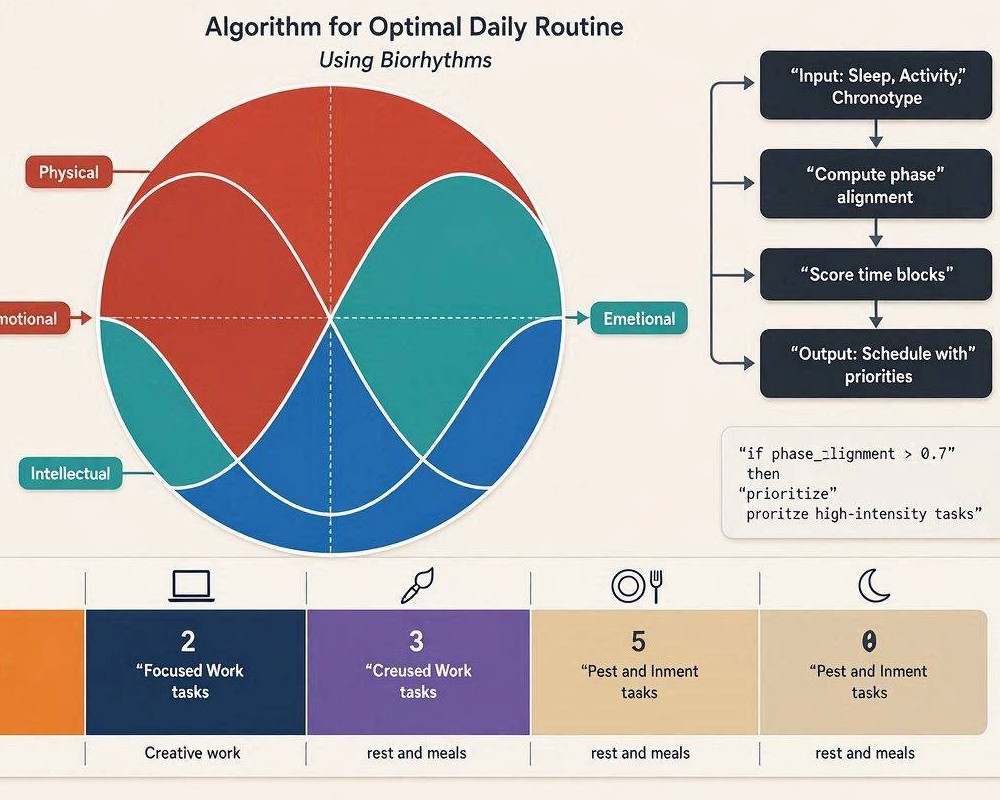
Why “optimal” differs from “maximum productivity”
The best algorithmic routine aims for long-term consistency. If it always schedules the hardest work during the highest peak, you may accumulate fatigue and reduce future peaks. Therefore, the system includes recovery strategy—short breaks, meal timing, light movement, and controlled workload variation.
In practice, optimization often means:
- Reducing transitions between task types to protect attention
- Using high-focus windows for tasks with the highest cost of errors
- Limiting late-day cognitive load when your predicted capacity falls
- Planning “buffer blocks” so one disruption doesn’t ruin the whole day
What a day looks like when the algorithm works
Consider a typical output: the system suggests a start time for deep work, a structure for meetings, and a training slot only if you can recover. On a day with lower predicted energy, it may shift effort toward low-friction tasks and add an earlier wind-down period.
Example routine logic
- Morning: deep work + limited interruptions during the focus peak
- Midday: planned meals and shorter tasks when energy stabilizes
- Afternoon: creativity or problem-solving during a secondary window
- Evening: light work, review, and early recovery steps before sleep
Limitations and responsible use
No algorithm can perfectly predict the human body. Stress from external events, illness, travel, and social obligations can override predicted cycles. That’s why the system should be adaptive, explainable, and privacy-conscious. It must also avoid medical claims—biorhythm-based scheduling complements healthy routines but cannot replace professional care.
Used responsibly, though, a biorhythm-informed algorithm can turn your day into a repeatable strategy: not rigid optimization, but a smarter alignment between your natural rhythms and your goals.