
In recent years, there has been a significant advancement in the field of Artificial Intelligence (AI) and Augmented Reality (AR). These technologies have become increasingly popular and have the potential to enhance virtual experiences in various fields such as gaming, education, healthcare, and...
An algorithm verifies the authenticity of paintings by brushstroke analysis
12
14.08.2026
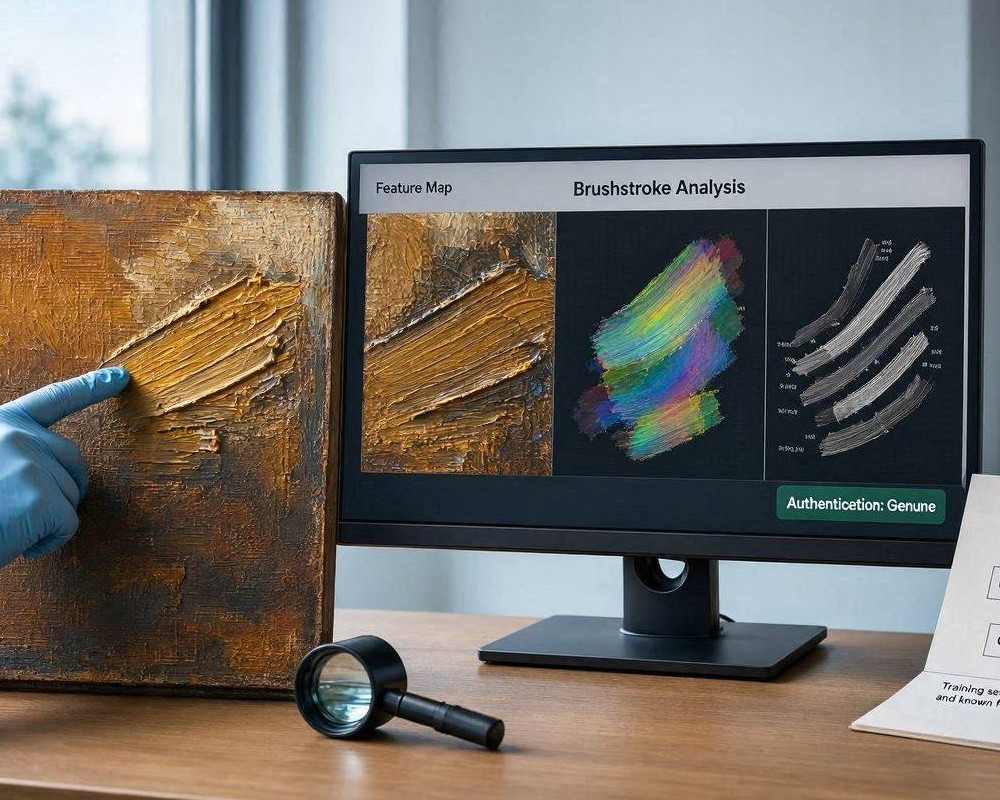
Art authentication has long relied on expert eye, provenance records, and material testing. Yet even specialists can disagree when a forgery mimics the visible surface. A modern approach—an algorithm that verifies authenticity through brushstroke analysis—adds a data-driven layer by measuring what a human eye often perceives only implicitly: the structure, direction, and physical logic of paint application.
Why brushstrokes matter more than appearances
A painting’s “look” can be imitated with pigment matching and aging techniques. Brushwork, however, carries the artist’s habitual decisions: how they load the brush, how quickly they move, where they press harder, and how they correct mistakes. Across many works, these choices repeat with statistical consistency.
Brushstrokes form a kind of signature that is not solely visual. It reflects the interaction between tool, medium, and time—factors that are difficult to reproduce perfectly, especially for forgeries produced at a later date.
How the brushstroke analysis algorithm works
At a high level, the algorithm treats each painting image as a texture map and extracts measurable stroke features. The process typically involves several stages:
1) Image capture and normalization
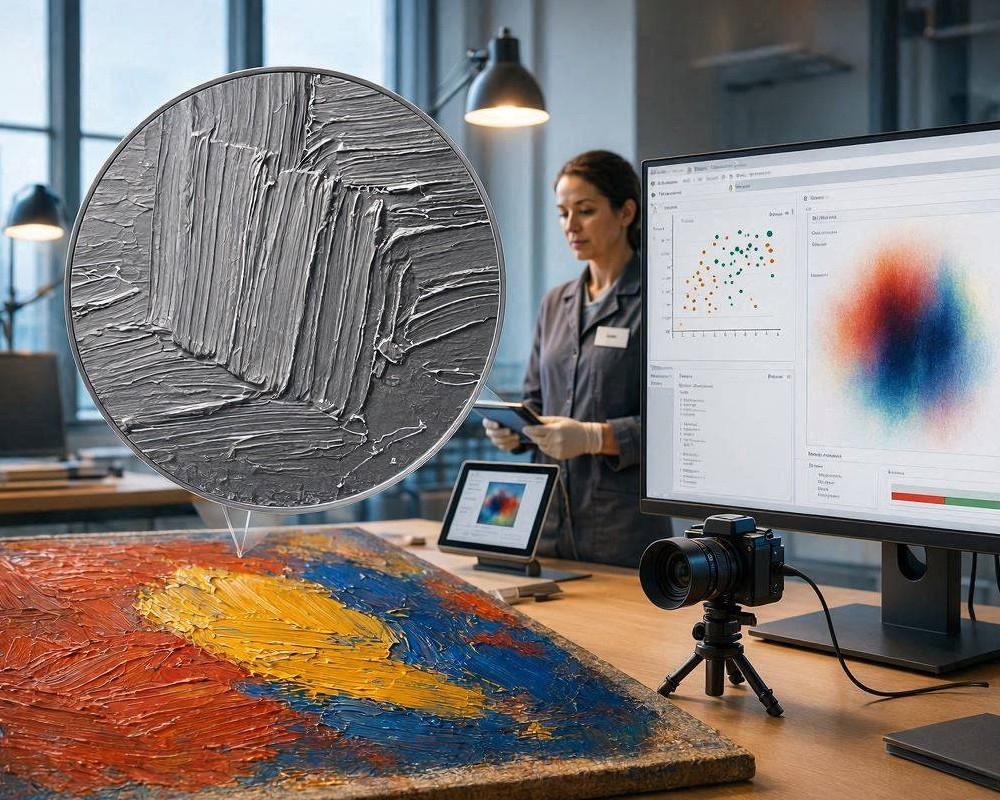
High-resolution imaging is essential. Many systems combine standard photography with techniques that reveal surface relief and paint boundaries, then normalize lighting and color so comparisons focus on brushwork rather than capture conditions.
2) Stroke segmentation and feature extraction
The algorithm segments regions where stroke boundaries and paint ridges are consistent. It then estimates properties such as:
- Stroke directionality and curvature distribution
- Spatial frequency of mark repetition (how often patterns occur)
- Edge sharpness and overlap behavior between strokes
- Local thickness proxies derived from surface contrast
3) Statistical comparison against known works
Authenticated paintings from the same artist—or from the same period, school, or studio—serve as reference data. The algorithm builds a statistical model of “expected brushwork behavior,” then scores how closely the test work matches that distribution.
Instead of asking “Is it identical?”, it answers “Does it follow the same brushwork logic?” That distinction is critical: it tolerates natural variation while detecting systematic deviations typical of copyists or workshop assistants.
Machine learning signals used to detect forgeries
Brushstroke analysis becomes most valuable when it captures subtle inconsistencies. Common signals include:
- Tool mismatch patterns: Forgeries may use different brush types or techniques, producing a distribution of stroke widths or edge profiles that diverges from the artist’s norm.
- Correction behavior: Real artists often revisit areas in characteristic ways—layering, blending, or scraping with a recognizable rhythm. Copies can emulate the final form but not the correction process.
- Temporal coherence: Brushwork evolves within an artist’s career. Algorithms can detect when stroke statistics resemble an earlier or later phase than the claimed date.
Scoring and confidence estimates
Most systems produce a probability-like score and confidence interval. A high score suggests compatibility with reference brushwork; a low score indicates features inconsistent with the model. Importantly, the output is rarely treated as a final verdict alone. It functions as a risk indicator that guides deeper investigation.
Strengths and limitations of this method
Strengths: Brushstroke analysis can be applied consistently and quickly once a reference library exists. It can also highlight which areas “drive” the mismatch, enabling conservators to focus their attention during visual examination.
Limitations: The algorithm depends on quality imaging and a meaningful dataset. If a reference set is small, biased, or not representative of the artist’s full range, the model may overfit. Additionally, some artists intentionally vary technique across commissions, and restoration work can alter surface texture, affecting stroke features.
For best results, brushstroke verification should be integrated with provenance review, pigment analysis, and—in advanced cases—non-invasive imaging that examines underdrawings and layers.
How experts use algorithmic results in practice
In a typical workflow, the algorithm flags suspicious regions and produces a compatibility score. Experts then correlate those findings with conservation history: whether the painting has been retouched, what materials are present, and whether the underlayers align with the claimed origin.
This hybrid approach reduces reliance on intuition alone. It turns brushwork from a qualitative impression into a measurable, testable hypothesis—supporting more reliable decisions for museums, collectors, and courts.
The future of authenticity verification
As datasets grow and imaging improves, brushstroke analysis will likely become more robust to restoration artifacts and lighting variability. Combined with material science and provenance analytics, algorithms can help form a comprehensive authenticity profile—one where brushwork is not just “seen,” but quantified and cross-validated.