

In recent years, there has been a significant advancement in the field of Artificial Intelligence (AI) and Augmented Reality (AR). These technologies have become increasingly popular and have the potential to enhance virtual experiences in various fields such as gaming, education, healthcare, and...
Neural Network Predicts Crop Yield Based on Weather Six Months in Advance
1084
15.03.2026
Revolutionary Agricultural Forecasting
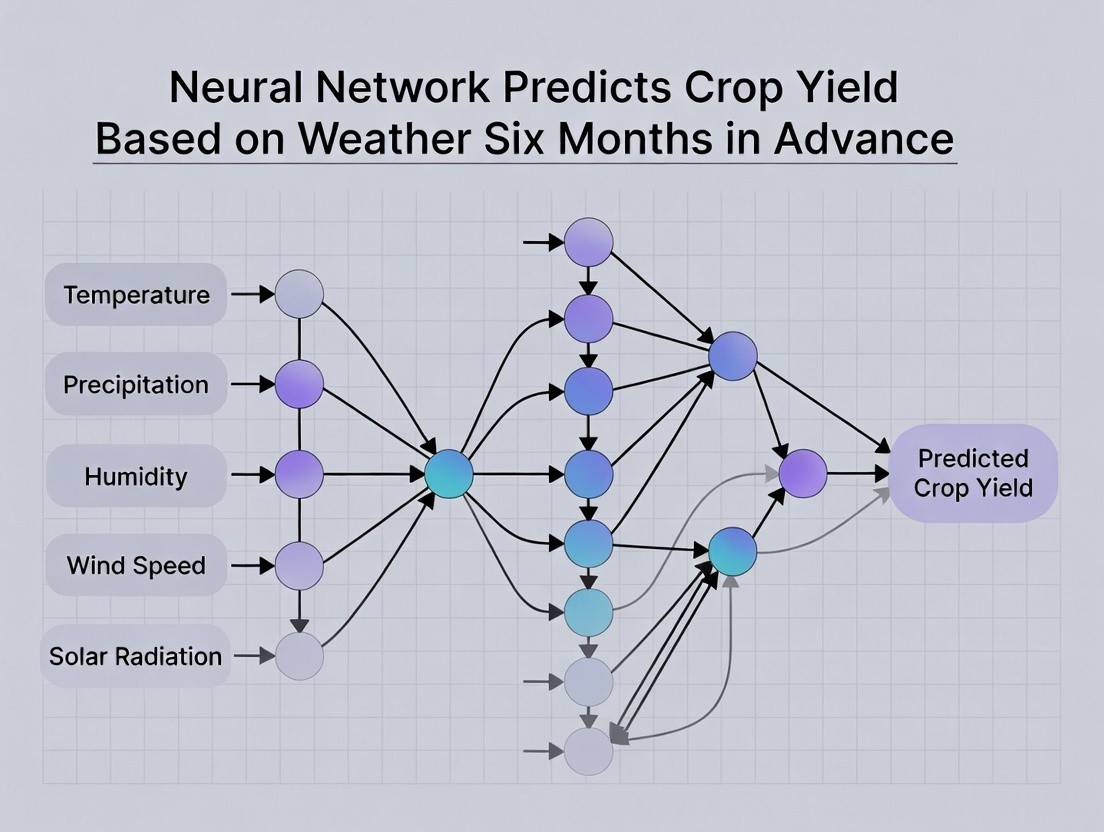
Agricultural innovation has reached a remarkable milestone with the development of a neural network capable of predicting crop yields with impressive accuracy based on weather data collected six months before harvest. This breakthrough technology promises to revolutionize farming practices worldwide, enabling farmers to make strategic decisions well in advance and optimize resource allocation for maximum productivity.
The Challenge of Agricultural Prediction
Traditional Limitations
Farmers have historically relied on experience, intuition, and short-term weather forecasts to plan agricultural activities. However, major decisions like crop selection, fertilizer application, irrigation scheduling, and resource allocation require information that extends far beyond traditional weather prediction capabilities. The inability to forecast growing season conditions creates uncertainty that impacts profitability and food security.
Why Six Months Matters
A six-month advance forecast covers the entire growing cycle for many crops, from planting through development to near-harvest maturity. This extended prediction window enables farmers to:
- Select optimal crop varieties suited to predicted conditions
- Plan irrigation and water resource management
- Schedule fertilizer applications strategically
- Arrange equipment and labor resources efficiently
- Negotiate prices and contracts with greater confidence
- Implement pest and disease management proactively
How the Neural Network Functions
Comprehensive Data Integration
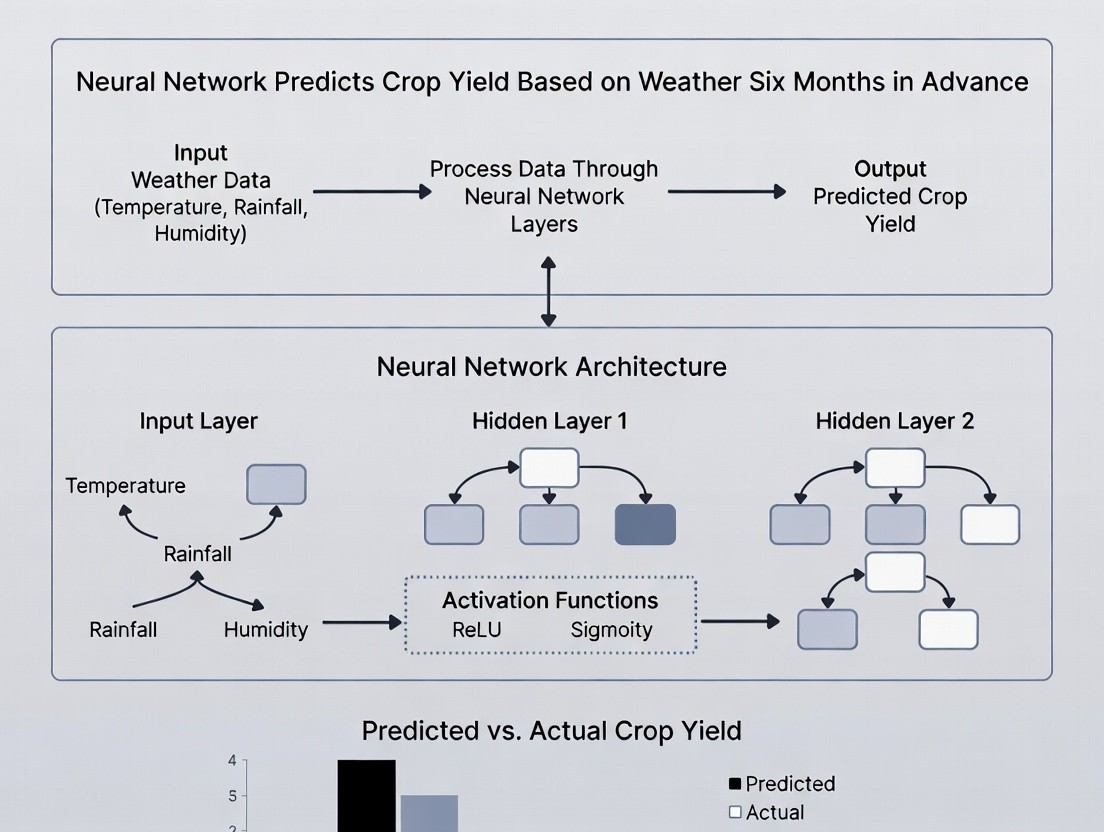
The system analyzes decades of historical weather and crop yield data from thousands of agricultural locations worldwide. The neural network examines patterns in temperature, precipitation, humidity, solar radiation, wind patterns, and soil conditions. By identifying correlations between weather patterns and agricultural outcomes, the algorithm learns to predict yields with remarkable accuracy.
Advanced Architecture
The neural network employs multiple layers including convolutional layers for spatial weather pattern analysis and recurrent layers for temporal sequence understanding. This architecture allows the system to recognize both immediate weather impacts and cumulative effects of weather conditions throughout the growing season. The algorithm considers not just average conditions but also weather extremes and anomalies that significantly affect crops.
Prediction Accuracy and Validation
Performance Metrics
Independent testing demonstrates that the neural network predicts crop yields within an average margin of error of approximately 7-10%, significantly better than traditional forecasting methods. For major crops including wheat, corn, rice, and soybeans, accuracy reaches 85-92% when predicting final yields six months in advance. This level of precision enables reliable decision-making and planning.
Geographic Adaptation
The system performs effectively across diverse geographic regions and climate zones. Regional neural networks trained on local data provide enhanced accuracy for specific areas. The global system captures broad patterns while regional variants optimize predictions for local climate characteristics, soil types, and agricultural practices.
Practical Applications
Farm-Level Decision Making
Individual farmers use yield predictions to inform planting decisions, select appropriate crop varieties, and plan resource allocation. A farmer receiving predictions of above-average moisture might plant crops that thrive in wet conditions, while predictions of drought enable preparation of drought-resistant varieties and efficient irrigation strategies. This strategic planning increases yields and reduces waste.
Agricultural Business and Economics
Commodity traders, food processing companies, and agricultural financial institutions benefit from improved yield predictions. Accurate forecasts reduce market uncertainty, enabling better pricing and contract negotiations. Lenders use predictions to assess farm viability more accurately, improving lending decisions and agricultural financing accessibility.
Government and Food Security
National governments and international food security organizations use the predictions for planning grain reserves, managing food imports and exports, and preventing food supply crises. Countries can anticipate potential shortages months in advance, enabling proactive measures to maintain food security and price stability.
Economic and Environmental Benefits
Increased Productivity
By optimizing agricultural decisions based on accurate yield predictions, farmers increase productivity per unit of land and resources. This intensification helps meet growing global food demands while potentially reducing the need for agricultural land expansion into sensitive ecosystems.
Reduced Environmental Impact
Strategic planning based on accurate predictions enables more efficient use of water, fertilizers, and pesticides. Rather than applying inputs universally as insurance against uncertainty, farmers apply exactly what predicted conditions require, reducing chemical runoff and water waste while maintaining yields.
Climate Resilience
Advanced yield prediction helps farmers adapt to climate change impacts. As weather patterns shift, the neural network captures these changes and reflects them in predictions. Farmers can adjust practices proactively, maintaining productivity despite increasingly variable conditions.
Implementation and Accessibility
User-Friendly Platforms
Agricultural organizations are developing accessible platforms delivering predictions to farmers through mobile applications and web interfaces. Farmers input field-specific information, and the system provides customized predictions. User-friendly design ensures adoption among farmers of varying technical sophistication.
Global Expansion
The technology is being deployed across major agricultural regions worldwide, with particular emphasis on developing countries where improved forecasting could dramatically enhance food security and farmer prosperity. International agricultural organizations partner with governments to ensure equitable access.
Conclusion
The neural network that predicts crop yields six months in advance represents a transformative advancement in agricultural technology. By harnessing artificial intelligence to identify complex relationships between weather and agricultural productivity, this innovation enables farmers to plan strategically, optimize resource use, and adapt to changing conditions. As the technology continues improving and expanding globally, it promises to increase food production, enhance environmental sustainability, and strengthen the resilience of agricultural systems worldwide. This breakthrough demonstrates how artificial intelligence, combined with domain expertise, solves real-world problems with profound implications for human welfare and planetary health.